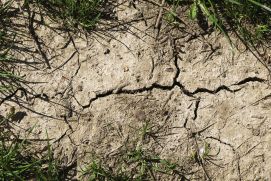
26.04.2018 Climate Climate change intensifies droughts in Europe - UFZ researchers model the effect Global warming will exacerbate soil droughts in Europe - droughts will last longer, affect greater areas, and have an impact on more people. If the earth warms by three degrees Celsius, extreme events - such as the drought which struck large parts of ... continue
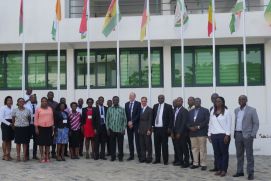
17.04.2018 Energy Germany's offer for a cooperation on renewable energies in Ghana takes off The Federal Ministry of Education and Research of Germany, (BMBF) and WASCAL have organized a one-day stakeholders workshop to share views, experiences and ideas on how renewable energies can be used to contribute to the development and implementation of ... continue
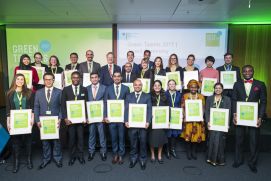
11.04.2018 Submission period for sustainability research award now open Become a Green Talent, promote your research in Germany and benefit from an exclusive network of excellent green researchers. continue
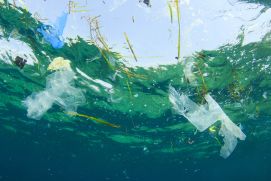
03.04.2018 MARE:N: Coastal, Marine and Polar Research for Sustainability 73 Percent of Fish In the Northwestern Atlantic Have Microplastics In Their Guts Researchers from Ireland and the United Kingdom have studied 233 fish, of which nearly three-quarters had tiny plastic particles called microplastics in their stomachs. The study was published in the journal Frontiers in Marine Science. continue
03.04.2018 Biodiversity ArnikaHessen honoured as a project of the UN-Decade on Biodiversity On 14th March 2018 ArnikaHessen, a joint project of the Botanical Gardens Marburg, Hochschule Geisenheim University and the Philipps University Marburg, was officially honoured as a project of the UN-Decade on Biodiversity. The award was presented by Dr. ... continue
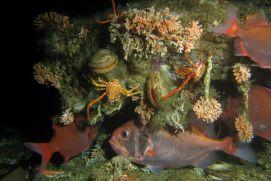
03.04.2018 MARE:N: Coastal, Marine and Polar Research for Sustainability Gigantic submarine cold-water coral mounds With a length of around 400 kilometers, the world’s largest contiguous cold-water coral structure stretches along the seafloor off the coast of Mauretania. Dr. Claudia Wienberg of MARUM – Center for Marine Environmental Sciences at the University of ... continue
29.03.2018 MARE:N: Coastal, Marine and Polar Research for Sustainability Anthropogenic lead still present in European Shelf Seas Over many decades lead (Pb) has been released into the atmosphere due to human activities, such as combustion of leaded fuel. A group of researchers led by the GEOMAR Helmholtz Centre for Ocean Research Kiel have now been able to show that following the ... continue
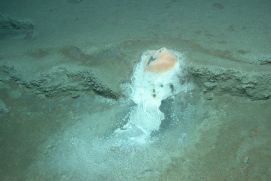
26.03.2018 MARE:N: Coastal, Marine and Polar Research for Sustainability Gas hydrate research: Advanced knowledge and new technologies Gas hydrates are ice-like compounds of water molecules with gases such as methane. They occur in large quantities in the continental slopes of ocean margins. Due to the enclosed methane, they are considered a potential source of energy. Funded by the ... continue
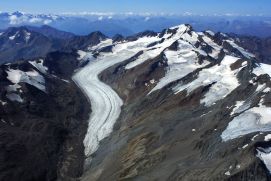
21.03.2018 MARE:N: Coastal, Marine and Polar Research for Sustainability Glacier mass loss: past the point of no return Researchers from the Universities of Bremen and Innsbruck show in a recent study that the further melting of glaciers cannot be prevented in the current century - even if all emissions were stopped now. However, due to the slow reaction of glaciers to ... continue
20.03.2018 MARE:N: Coastal, Marine and Polar Research for Sustainability Stromatolites in the deep sea - Research team discovers fossils at 730 meter wat Stromatolites are among the oldest fossils with 3.5 billion years. Up to now, however, lime deposits have only occurred in shallow seas with water depths of up to ten meters. The lime layers can only grow if microorganisms that carry out ... continue
19.03.2018 Geosciences MARE:N: Coastal, Marine and Polar Research for Sustainability Thawing permafrost produces more methane than expected In a seven-year laboratory study, Dr. Christian Knoblauch from Universität Hamburg's Center for Earth System Research and Sustainability (CEN) and an international team have shown, for the first time, that significantly more methane is produced by thawing ... continue
14.03.2018 MARE:N: Coastal, Marine and Polar Research for Sustainability Wandering greenhouse gas On the seafloor of the shallow coastal regions north of Siberia, microorganisms produce methane when they break down plant remains. If this greenhouse gas finds its way into the water, it can also become trapped in the sea ice that forms in these coastal ... continue
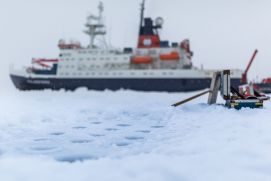
13.03.2018 MARE:N: Coastal, Marine and Polar Research for Sustainability Unique insights into the Antarctic ice shelf system The world's second-largest ice shelf was the destination for a POLARSTERN expedition that ended in Punta Arenas, Chile on 14th March 2018. Oceanographers from the Alfred Wegener Institute, together with German and international colleagues, have collected ... continue
13.03.2018 MARE:N: Coastal, Marine and Polar Research for Sustainability Warm summers could weaken ocean circulation In winter, cold water masses in the North Atlantic sink from the sea surface into the deep ocean. This process, known as convection, is one of the key components of the large-scale ocean circulation. Based on long-term observations, scientists from the ... continue
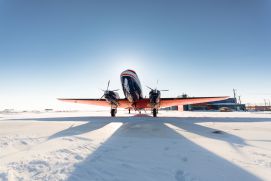
12.03.2018 MARE:N: Coastal, Marine and Polar Research for Sustainability Surveying the Arctic: Tracking down carbon particles On 15 March, the AWI research aeroplane Polar 5 will depart for Greenland. Concentrating on the furthest northeast region of the island, an international team of researchers will spend the next four weeks studying how the Arctic is changing. In the course ... continue