

URA – Urban-Rural Assembly: Strategic tools for integrated territorial planning enhancing urban-rural integration and circular economies in the Huangyan-Taizhou region
Sustainable urban-rural systems are the building blocks of a regenerative economic and social model: Using an interdisciplinary and transdisciplinary research approach with focus on real-world laboratories in China and Germany, the URA project has developed strategic planning tools for this purpose.
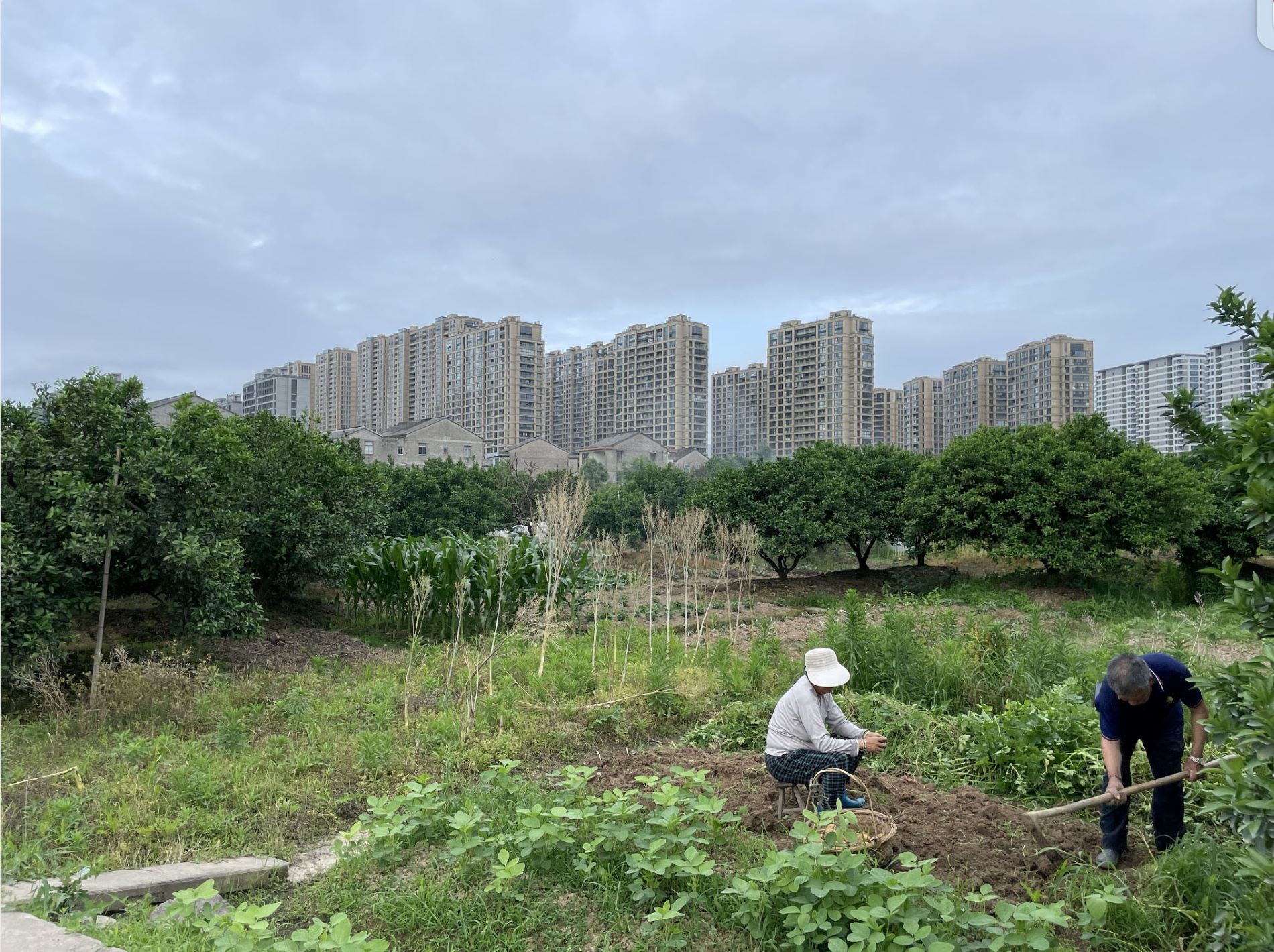
Even today, in what has long been proclaimed the ‘urban age,’ nearly half of the world's population continues to live in areas defined as ‘rural.’ These mostly productive landscapes cover large parts of the global landmass, whereas urban settlements occupy only around three percent of the Earth's surface. However, the ‘countryside’ has not yet received the attention it deserves in urban research and practice as a supplier of essential resources such as food, water, energy and building materials for city dwellers. At the same time, non-urban areas absorb the various emissions and waste products of urban life.
To address the urban planning challenges posed by multiple crises, particularly climate change, from a holistic perspective, we must examine the tangible and intangible interrelationships between urban and rural areas – this is the initial thesis of the joint research project ‘Urban-Rural Assembly (URA)’. We need to understand the diverse external and internal interdependencies of regions in order to develop planning visions for a more resilient future – across urban-rural boundaries. However, conventional urban and regional planning is still based on existing administrative units, which usually distinguish between urban and rural areas. Using a transdisciplinary and transformative research approach, the URA project has developed and tested strategies and tools for integrated urban-rural planning: the ‘co-visioning’ approach for urban-rural regions promotes systemic thinking across administrative and sectoral boundaries and involves local actors in the development of regional planning models (such as ‘spatial images’).
In China, the urban-rural divide is particularly acute: not only are there rapidly growing urban regions, but also rural areas that are lagging behind in economic development and shrinking rapidly. At the same time, the country has been a pioneer in testing planning strategies for the urbanization of rural areas for the past twenty years. Case study of the research project was the eastern Chinese urban-rural region of Huangyan-Taizhou in Zhejiang Province. Located on the southern edge of the Yangtze River Delta, a highly dynamic urbanization corridor, it served as a prototypical urban-rural learning context in which diverse and seemingly contradictory transformation processes are taking place that are redefining the relationships between the city and its surrounding areas. The German-Chinese multidisciplinary project consortium investigated the translocal interrelationships at the urban-rural interface with regard to landscape transformation, ecological change, social inclusion and exclusion, circular economy, and local economy. In doing so, it identified the intertwined social, economic, and ecological risks of these dynamics and the planning policy tasks involved, but also identified local innovations that could point to new paths to sustainability.
Using the co-visioning approach, which was initially tested in the Nordhausen region (Thuringia), the project developed scenarios for the sustainable transformation of the Huangyan region and two areas of focus (urban-rural living labs) based on the results of multidisciplinary analyses. The key outcome of the research is the development of the 'co-visioning' planning method, which can also be applied to other contexts. With the help of this method, regional visions for the future and action strategies for sustainable transformation are developed in participatory multi-stakeholder workshops based on an in-depth understanding of urban-rural relationships. The project work was accompanied by ongoing science-policy dialogue in order to transfer the research findings into policy and planning. The co-visioning approach was ultimately explained in a policy paper published jointly with UN-Habitat and in a short film, and other important project findings were published in a final report.
Project lead:
Prof. Dr. Anke Hagemann
Technische Universität Berlin, Faculty VI – Planning Building Environment, Institute of Architecture, Chair of International Urbanism and Design (Habitat Unit)
Straße des 17. Juni 152, A 53
10623 Berlin
Phone: +49 30 314 21908
E-Mail: hagemann@tu-berlin.de
Partners of the project:
- Bauhaus-Universität Weimar
- Leibniz Institute of Ecological Urban and Regional Development
- Tongji University Shanghai
Last updated on